Guide
Your First Pottery Class: What Actually Happens
A minute-by-minute account of a first pottery session — what to wear, what your hands will do, the moment everyone struggles, and what you leave with.
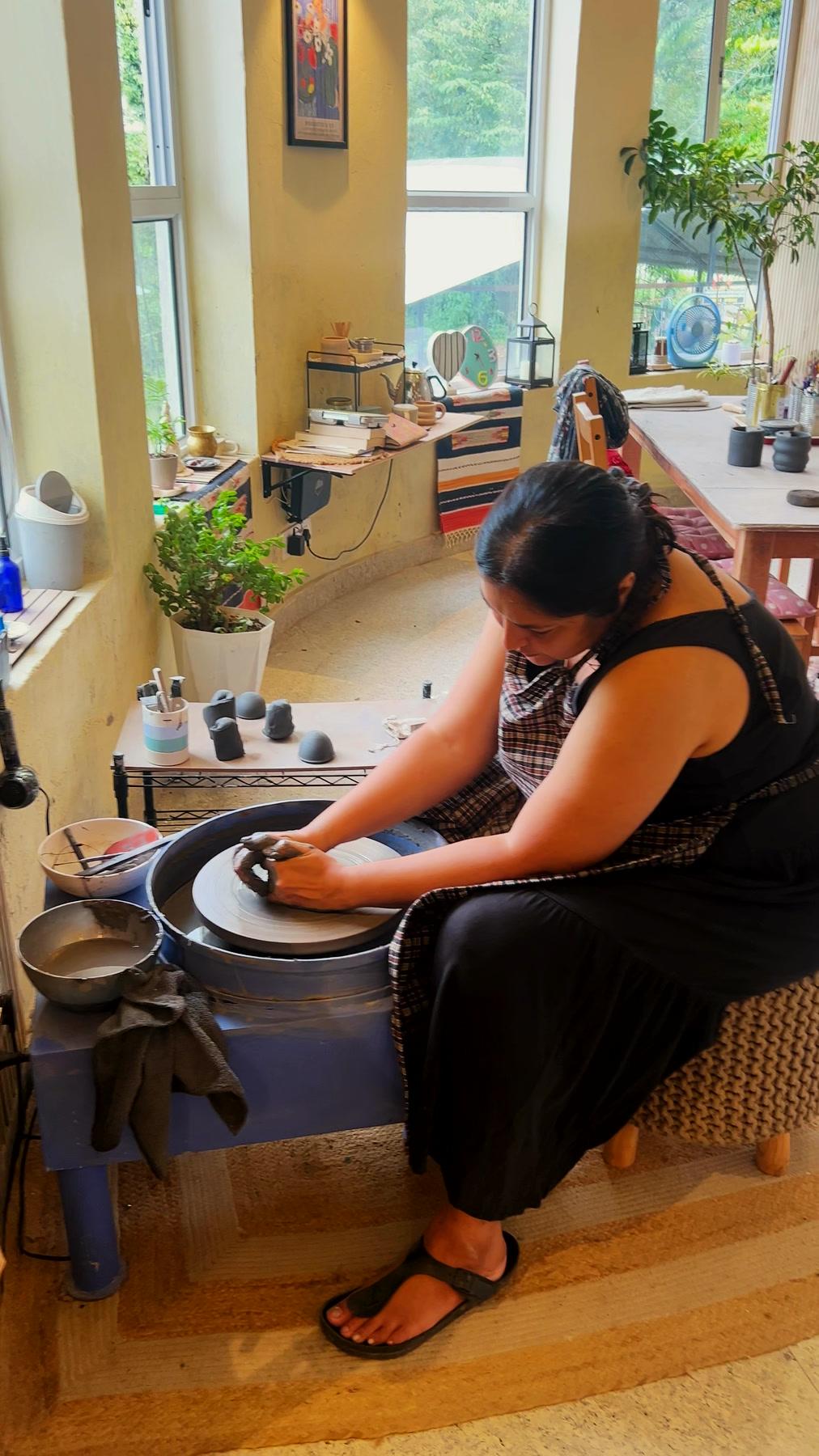
Most people arrive at a first pottery class with one of two pictures in their head: the film scene, or a vague sense that they will be bad at it.
Neither is much use. Here is what actually happens, roughly in order, so you can turn up knowing what the afternoon asks of you.
Before you come
Wear something you do not mind marking. Clay washes out of most fabrics but not reliably out of everything, and slip dries to a fine pale dust that finds dark clothes. Aprons are provided; sleeves are the problem.
Short nails help. Long nails make pinching and centring genuinely harder — you press with the pad of the finger, and a nail gets in the way of feeling thickness. Not a rule, just physics.
Take rings off. They score the clay and clay gets into settings.
Eat first. Two hours of concentration is longer than it sounds.
The first ten minutes: not making anything
Every session here starts with the clay itself rather than a technique — wedging it, pressing it, learning what "too wet" and "too dry" feel like in the hand.
This reliably feels like a delay and is the opposite. Nearly every problem later in a session traces back to clay at the wrong consistency that nobody noticed at the start. It is also the part that quietly resets people: you cannot think about your inbox while working out how hard to push something.
The middle: the part nobody warns you about
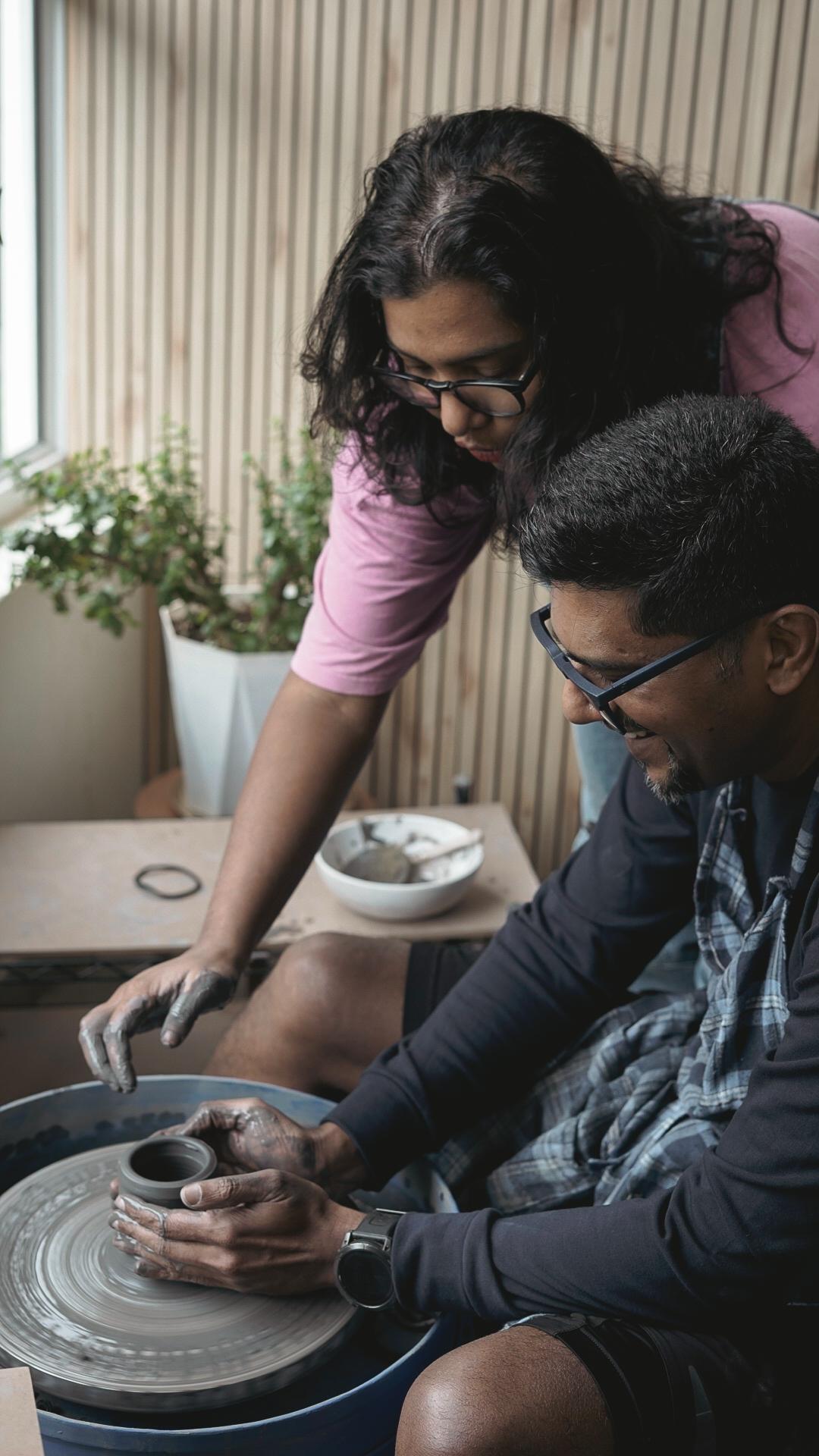
Somewhere around forty minutes, most people hit the same wall.
The piece is uneven. One side is thinner than the other. The instinct — and it is a strong one — is to keep thinning the thick side to match, which thins the whole thing until it collapses or cracks later.
This is the moment the teaching matters, and it is the entire argument for small groups. Someone has to notice it happening to you specifically and say "stop, that side is fine". At six people, and four at the wheel, that is possible. In a room of twenty it is not.
If you are at the wheel, the equivalent moment is centring. Centring is unglamorous, it is most of what throwing is, and almost nobody centres a lump cleanly on their first afternoon. That is not a failure — it is the skill, and it takes hours of contact, not minutes.
The last stretch: finishing
Smoothing. Attaching a handle if the form takes one. Marking the base — usually your initials, sometimes the date, and this matters more than it sounds when the piece comes back to you weeks later among other people's.
Then thirty minutes of clean-up. Clay gets everywhere, and washing tools and wiping down the table is genuinely part of pottery rather than an afterthought the studio should hide from you. It is why our clay sessions book a two-hour block for ninety minutes of making.
What you leave with
Almost certainly not your pot.
Anything made from raw clay has to dry, be bisque-fired, be glazed and fired again — three to six weeks, and no studio can compress it. The full sequence is in the seven stages of clay if you want to understand why.
What you leave with instead: a photograph, dust on your forearms, and a surprisingly specific memory of how the material behaved. People describe the after-effect the way they describe a long walk.
If you are travelling and the wait does not work, a Sip & Paint session — acrylic on an already-fired piece — takes about an hour and goes home with you the same day. Or we ship, ₹200 a piece within India.
Honest expectations about the object
Your first piece will not look like the shop. Walls will be uneven, the rim will wobble slightly, the handle will sit at a very slightly personal angle.
We think that is the point, and we would rather say so now than have you disappointed later. A machine can make you a perfect cylinder for two hundred rupees. What it cannot make is the one you made.
Some pieces do not survive firing. It is uncommon but not rare, and it is usually the over-thinned ones. We will tell you honestly if it happened and what we can do about it.
Who tends to enjoy it most
People who like process more than outcome. People who want two hours where a phone is genuinely inconvenient to hold. Children from about five, who are usually better at it than their parents because they are not trying to be good at it.
People who want a guaranteed beautiful object in ninety minutes tend to leave frustrated, and we would rather point them at painting a bisque piece than sell them a wheel session.
Come and find out
Formats, prices and what each one leaves you holding are on the workshops page. Wondering what it costs and whether that is reasonable? We published what pottery classes cost across India, ours included.
Or just message the studio on WhatsApp and describe what you are after — we will tell you which session fits, including if the answer is none of them.
Keep exploring
Book a session
Tell us the dates you are around and we will confirm a slot — or just message +91 88796 54294 and ask us anything first.